EFG Eurobank | Digital Product
In this workshop, participants embarked on an in-depth journey through the core principles of design thinking, gaining not only a deep understanding of its process but also the tools and methodologies crucial for analyzing intricate problems. A strong emphasis was placed on team building, which was part of the internal contest for innovation at Eurobank, as they learned how to form collaborative and dynamic teams, fostering a culture of creativity and innovation
What we achieved
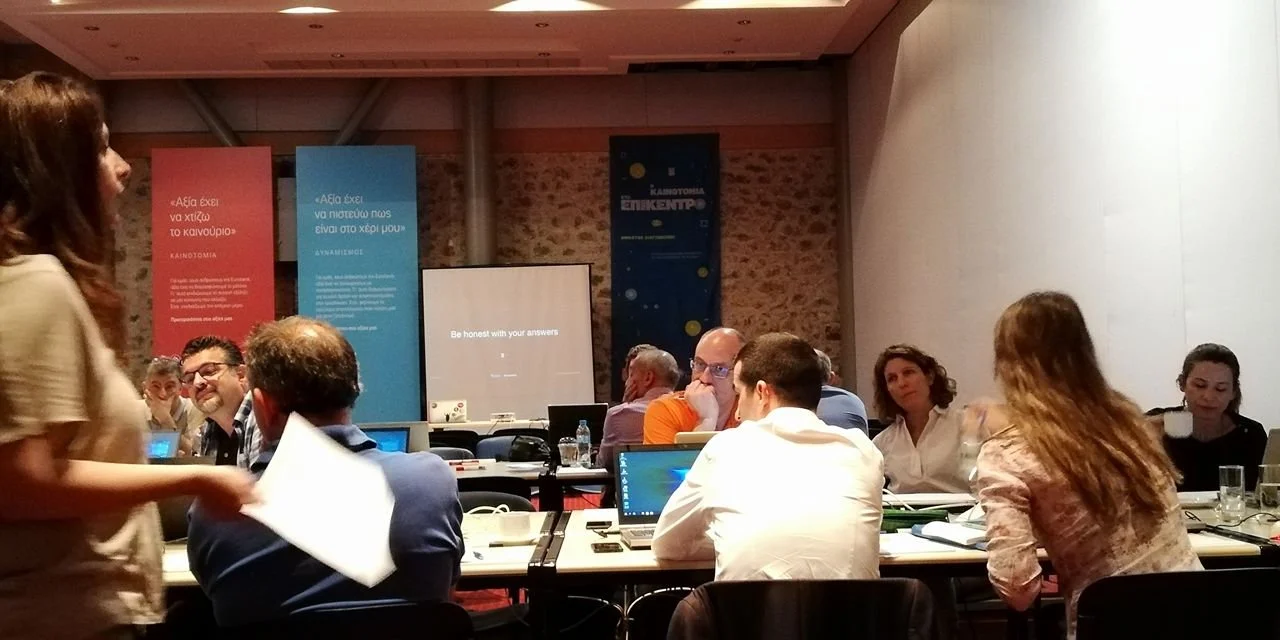
Innovation is not something organisations have. It is something people inside them practise, together, deliberately, and with the right tools. This workshop was about giving those tools to the people who needed them most.
Goal 1 | Deep fluency in Design Thinking, not just familiarity with it. There is a version of Design Thinking that gets taught in an afternoon, a surface-level tour of five stages that leaves participants nodding along but no more capable than when they arrived. This was not that workshop. The ambition from the outset was depth: a genuine, working understanding of the process, the reasoning behind each phase, and the judgment to know when to move forward and when to stay longer in the discomfort of a problem not yet fully understood. Participants left not just knowing what Design Thinking is, but knowing how to use it — on real problems, in real time, under real pressure.
Goal 2 | Mastery of the tools and methodologies behind complex problem analysis. Design Thinking is only as powerful as the tools used to apply it. This workshop gave participants hands-on experience with the methodologies that make the process actionable, from empathy mapping and stakeholder analysis to problem framing, ideation techniques, and rapid prototyping. The emphasis throughout was on application, not theory: every tool was introduced in the context of a real challenge, tested through a live exercise, and reflected upon before moving to the next. Participants did not just learn the tools. they developed a feel for when to reach for which one.
Goal 3 | Building teams that are genuinely collaborative, not just co-located. Team building was not a warm-up exercise or an icebreaker appended to the real content. It was structural, woven through the entire workshop as a core learning objective in its own right. This was particularly significant given the workshop's context: Eurobank's internal innovation contest, where the ability to form dynamic, high-functioning teams was not a soft skill but a competitive requirement. Participants explored how diverse thinking styles complement each other under creative pressure, how to navigate disagreement productively, and how to build the kind of psychological safety that allows genuinely new ideas to surface. The teams that emerged from this workshop were not just better at Design Thinking. They were better at working together.
Goal 4 | Fostering a culture of creativity and innovation from the inside. A workshop can teach a methodology. What it cannot always do is shift a culture. This one tried — and made meaningful progress. By embedding Design Thinking within the context of Eurobank's own innovation contest, the learning was immediately purposeful. Participants were not practising on hypothetical problems. They were developing real capabilities in the service of a real organisational goal. That alignment between learning and application created something more durable than skill acquisition: it planted the seed of a creative culture, one where innovation is not the responsibility of a dedicated team but a capacity distributed across the organisation.
Goal 5 | Making innovation feel achievable, not aspirational. One of the quieter but more important outcomes of this workshop was attitudinal. Innovation, for many professionals working inside large financial institutions, can feel like something that happens elsewhere, in startups, in tech companies, in rooms full of people who are somehow more creative. This workshop worked against that assumption at every turn. By showing participants that the tools of innovation are learnable, that creative thinking is a practice rather than a gift, and that the constraints of a structured organisation are not incompatible with genuinely new ideas, it made innovation feel closer. More possible. More theirs.
Goal 6 | Linking individual growth to organisational momentum. The internal contest format created a productive tension that shaped the entire workshop experience. Participants were growing individually, building new skills, new confidence, new ways of seeing problems, while simultaneously contributing to something larger: Eurobank's organisational push toward a more innovative culture. That double purpose gave the learning an urgency and a meaning that purely skills-focused training rarely achieves. Every participant left knowing that what they had developed in the room had a place to go, a contest to enter, a team to contribute to, and an organisation paying attention.